From Fragmented to Unified: The New Architecture for Global E-Commerce
Learn why leading e-commerce brands are replacing fragmented 3PL systems with unified logistics platforms to scale across markets faster and more efficiently.
Published: Dec 11, 2025
Last Edited: Mar 26, 2026

The reality: Every new market you enter costs you 60 - 180 days and USD $15K in integration work. Unless you're using the wrong architecture.
Your competitors are managing logistics like it's 2018: one 3PL per country, four dashboards, zero unified intelligence. Here's why that's a structural disadvantage.
The Multi-Market Scaling Problem
When brands hit USD $3-5M in revenue, international expansion becomes the obvious next move. But here's what actually happens:
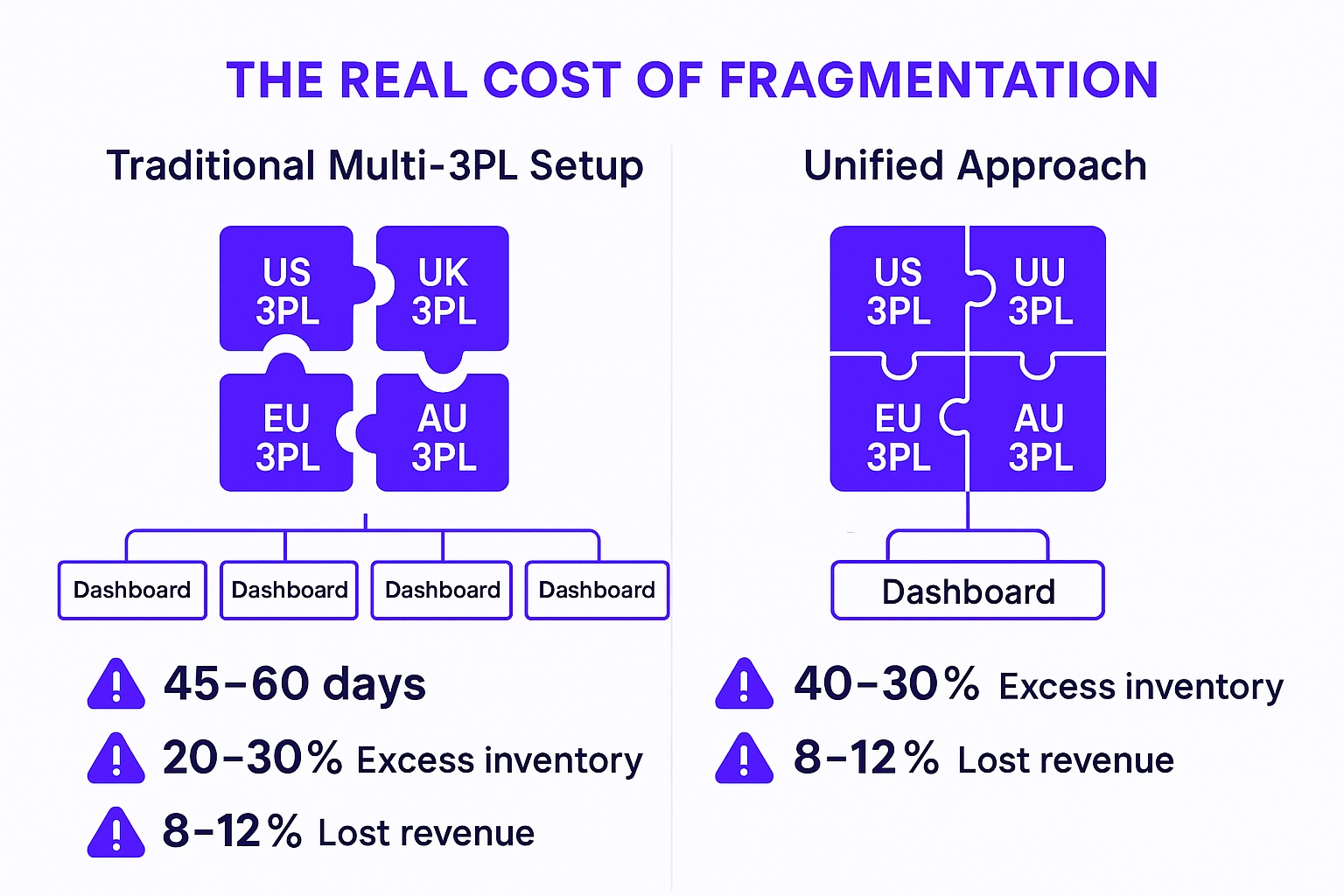
You sign with a new 3PL in each market. Each requires separate integrations. Your data now lives in 3-4 disconnected systems. According to research from Filuet, supply chain fragmentation is one of the biggest operational hurdles in cross-border e-commerce, leading to miscommunication, unexpected fees, and delivery delays.
The business impact: each integration averages 45-60 days of engineering time. Inventory trapped in one market while stockouts happen in another costs brands 8-12% in lost revenue. Without unified visibility, brands overstock by 20-30% to buffer for uncertainty.
Cross-border e-commerce logistics hit $200 billion in 2024 and is projected to reach $400 billion by 2033. Yet businesses still struggle with the same problems: high logistics costs, complex compliance, and zero cross-visibility between markets. The technology exists to solve this—but most brands are bolting AI onto fragmented infrastructure instead of fixing the architecture underneath.
The Architecture Problem Starts at Origin
If you're manufacturing in China—which most Western e-commerce brands are—the inefficiencies start before your product leaves the country. Traditional models mean multiple handoffs: supplier to consolidation centre (that you don't control), to freight forwarder, through export customs, onto aircraft, through destination customs, to final-mile delivery. Every handoff is a data gap. Every vendor transition is a potential delay.
The alternative is controlling the consolidation infrastructure itself. When you own the facilities in Guangzhou where products are consolidated and prepared for export—when that same platform manages customs clearance, aircraft space, and destination fulfillment—the data gaps disappear. Not because you've built integrations between vendors, but because there are no vendor boundaries to integrate across.
This is the difference between coordinating a supply chain and owning one.
How Unified Architecture Changes Everything
Instead of stitching together disconnected 3PLs, a single-platform approach across multiple countries eliminates integration hell entirely. Your inventory in LA can intelligently route to UK customers via direct injection, or pre-position in a UK facility based on AI demand forecasting. Same system, same data layer, same interface.
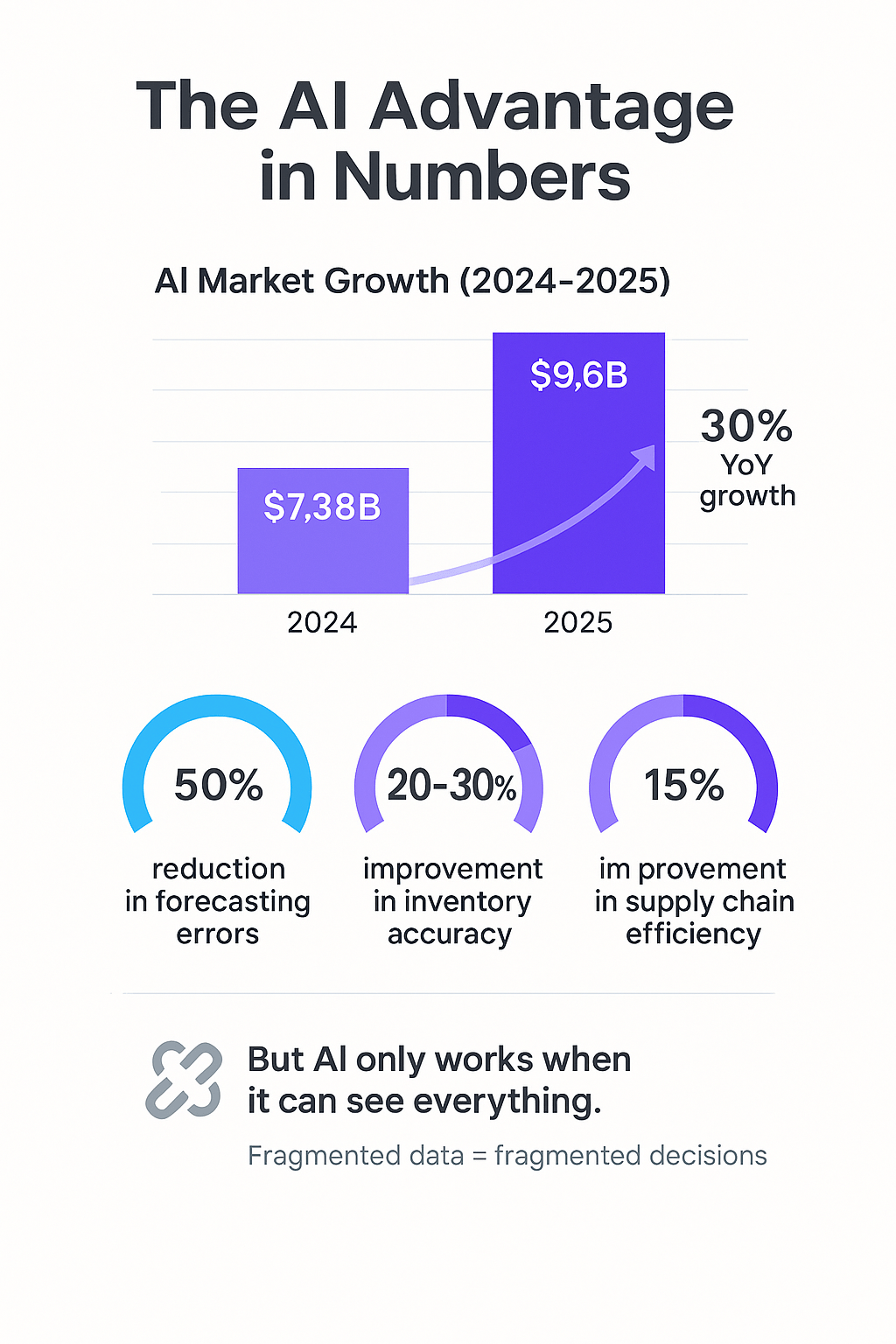
Companies using AI in demand planning report up to 50% reduction in forecasting errors and 20-30% improvement in inventory accuracy. But AI only works when it can see everything. Fragmented data across four dashboards means no algorithm can optimise your global inventory position.
Direct Injection: The Bridge That Makes It Work
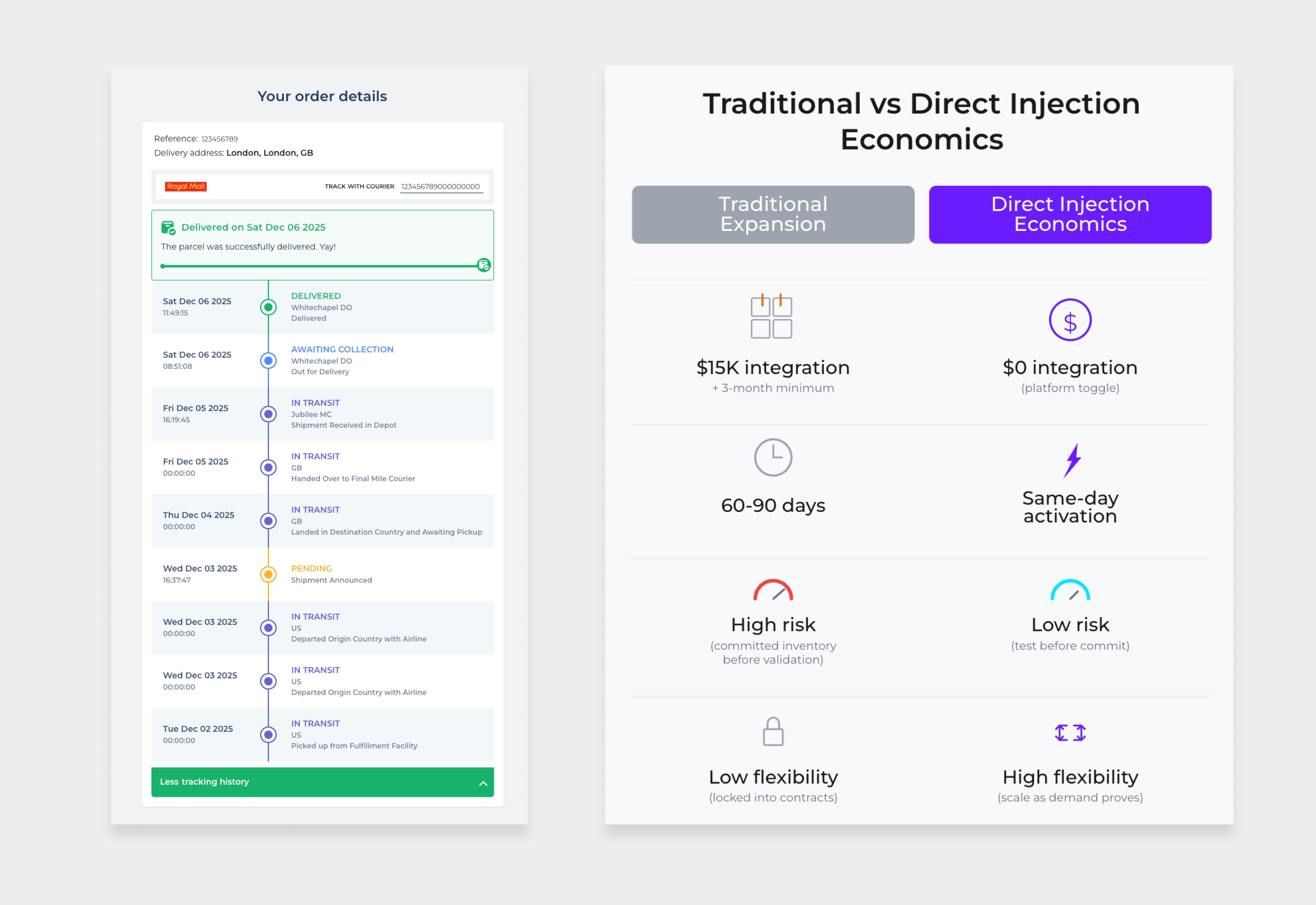
Direct injection shipping lets you serve new markets from existing inventory locations—launch in the UK without a UK warehouse, shipping from US stock at competitive speeds. Once volume justifies local inventory, you transition seamlessly.
But direct injection only works when you control upstream infrastructure. If you're picking up from third-party warehouses and consolidating at sorting centres you don't own, you're adding 2-4 days before the "direct" part begins.
When fulfillment and direct injection operate on the same platform, with dedicated airline capacity already allocated, the speed advantage is real: 4-6 day delivery windows versus 7-14 days via traditional international shipping. Complete tracking visibility at every stage, customs pre-cleared via DDP so customers pay nothing at delivery.
The Expansion Playbook

Here's how brands scale internationally without integration hell:
Start: Fulfill US orders from a US warehouse.
Month 3: UK orders spike—activate US→UK direct injection via the same platform.
Month 6: UK volume justifies local stock—activate UK fulfilment, AI rebalances inventory automatically.
Month 9: EU expansion—same system, same AI, zero new integrations.
Each market addition is a toggle, not a six-month integration project.
The 2026 Advantage
Your competitors are still playing the old game: new market = new 3PL contract = 60-day integration = another data silo.
You're playing a different game: new market = platform toggle = same AI = zero integration time.
The brands winning at global e-commerce aren't the ones with the biggest logistics budgets. They're the ones who recognised that in 2026, supply chain architecture is competitive moat.
Eight countries. One system. Zero integration hell.
Ready to Transform Your Logistics?
Book a call to optimise costs, boost efficiency, and enhance satisfaction!
