Hidden Costs of International Expansion: Why the Second Country Breaks Your Logistics
Why the second country breaks logistics: inventory locks up capital, CS queries take 10× longer, tracking fragments, and teams shift to coordination mode.
Published: Jan 22, 2026
Last Edited: Mar 26, 2026

If you're building an ecommerce brand, the first market teaches you how to move. The second teaches you how fragile your systems really are.
The jump from one country to two is where complexity quietly creeps in. Not because anything is wrong, but because the structure underneath hasn't changed yet.
The Second Country Is Structural, Not Linear
In a single-country setup, logistics is mostly linear. One warehouse, one carrier network, one set of delivery promises. The second country introduces a structural shift. Inventory must be redistributed across borders. Customs rules enter the picture. Lead times stretch and become variable. Cross-border complexity consistently introduces disproportionate cost and coordination overhead relative to volume growth.
When you add a second country, small changes compound

Stock is duplicated across borders, introducing 20–30% annual carrying costs.

Different warehouses, carriers, and tracking systems turn simple questions into operational work.

Teams reconcile data across systems instead of acting on it.

Instead of moving orders, teams stitch processes together.
This is where fragmentation replaces unified architecture—and margins start leaking.
Inventory Multiplication: The Working Capital Trap
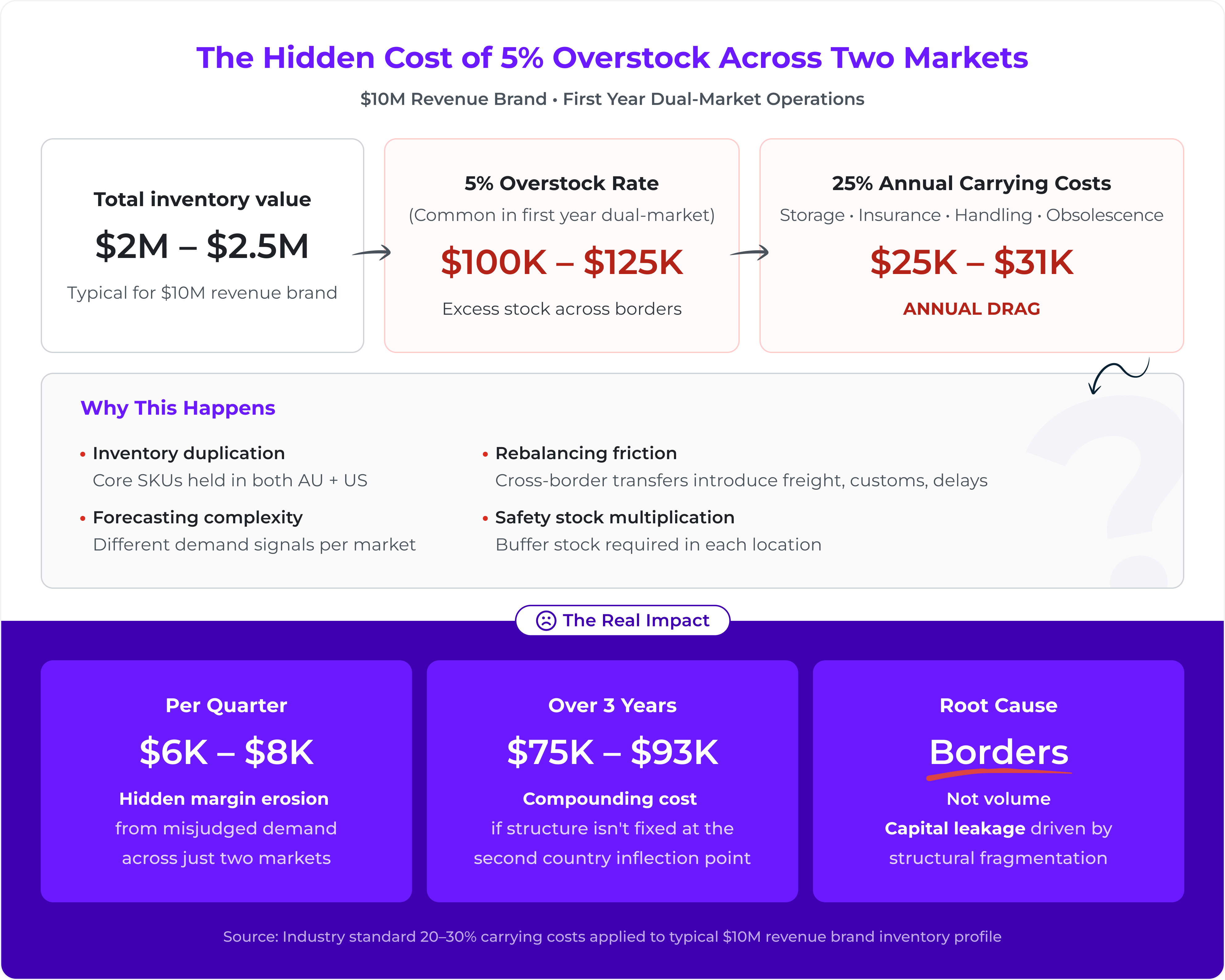
The moment stock splits across countries, inventory stops being a single pool and becomes multiple risk surfaces. Take a brand fulfilling from Australia that enters the US. Core SKUs are duplicated in both regions. Rebalancing stock between markets is no longer a simple warehouse transfer—it introduces international freight, customs clearance, duties, and landed cost uncertainty.
Capital tied up in stock effectively doubles. Inventory carrying costs typically run at 20–30% of inventory value per year once storage, insurance, handling, and obsolescence are factored in.
Here's what that means in real numbers: A brand doing $10M in revenue typically holds $2M–$2.5M in inventory. With a 5% overstock rate across two markets (common during the first year), that's $100K–$125K in excess stock. At 25% annual carrying costs, that's $25K–$31K in annual drag—just from slightly misjudging demand across borders.
Forecasting errors compound because teams forecast independently for two markets with different seasonality, promotions, and customer behavior. Excess stock builds in one market while the other risks stockouts.
When Customer Service Fluency Breaks
In a single market, customer service teams develop instinctive fluency. They know where to look, who to escalate to, and how long things usually take. Tracking statuses are familiar. Delivery windows are predictable. Exceptions follow known patterns.
The second country breaks that muscle memory.
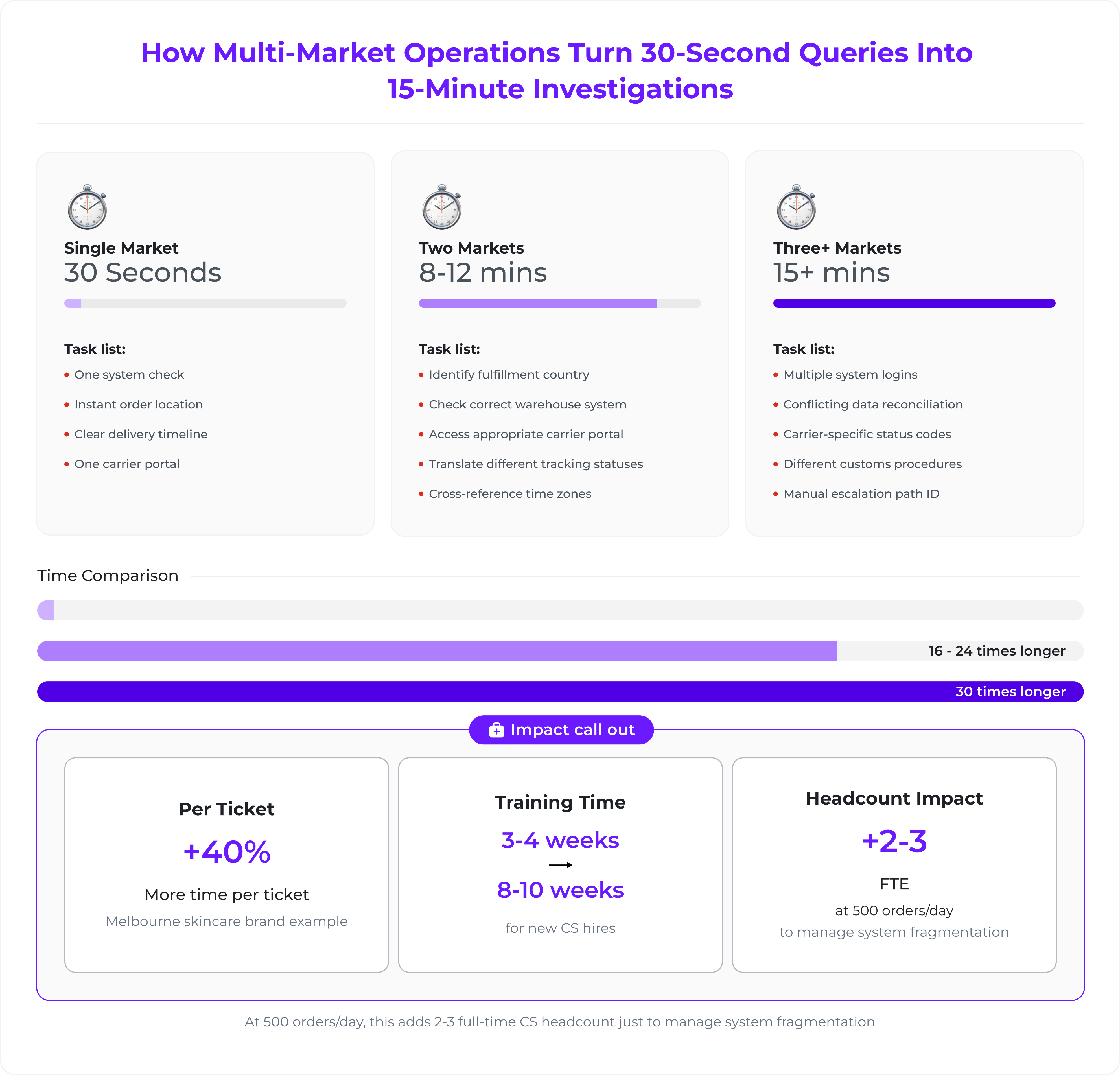
Suddenly there are different warehouses, different carriers, different delivery windows, and often different time zones. A simple "where's my order?" query now requires identifying which country the order shipped from, logging into the correct carrier portal, and interpreting tracking statuses that mean different things depending on the network behind them.
What this looks like in practice:

Agents first need to determine fulfillment location, then access the correct carrier system, then translate unfamiliar status codes.
New hires must learn multiple systems, carrier behaviors, and escalation paths instead of one.

Different delivery timelines and update patterns create confusion, even when performance is technically "on time".

Time is spent managing expectations created by fragmented systems rather than fixing underlying issues.
Without unified tracking visibility, even on-time deliveries can feel uncertain to customers—because the systems themselves don't provide consistent, clear information across markets.
When Reporting Moves From Real-Time to Retroactive
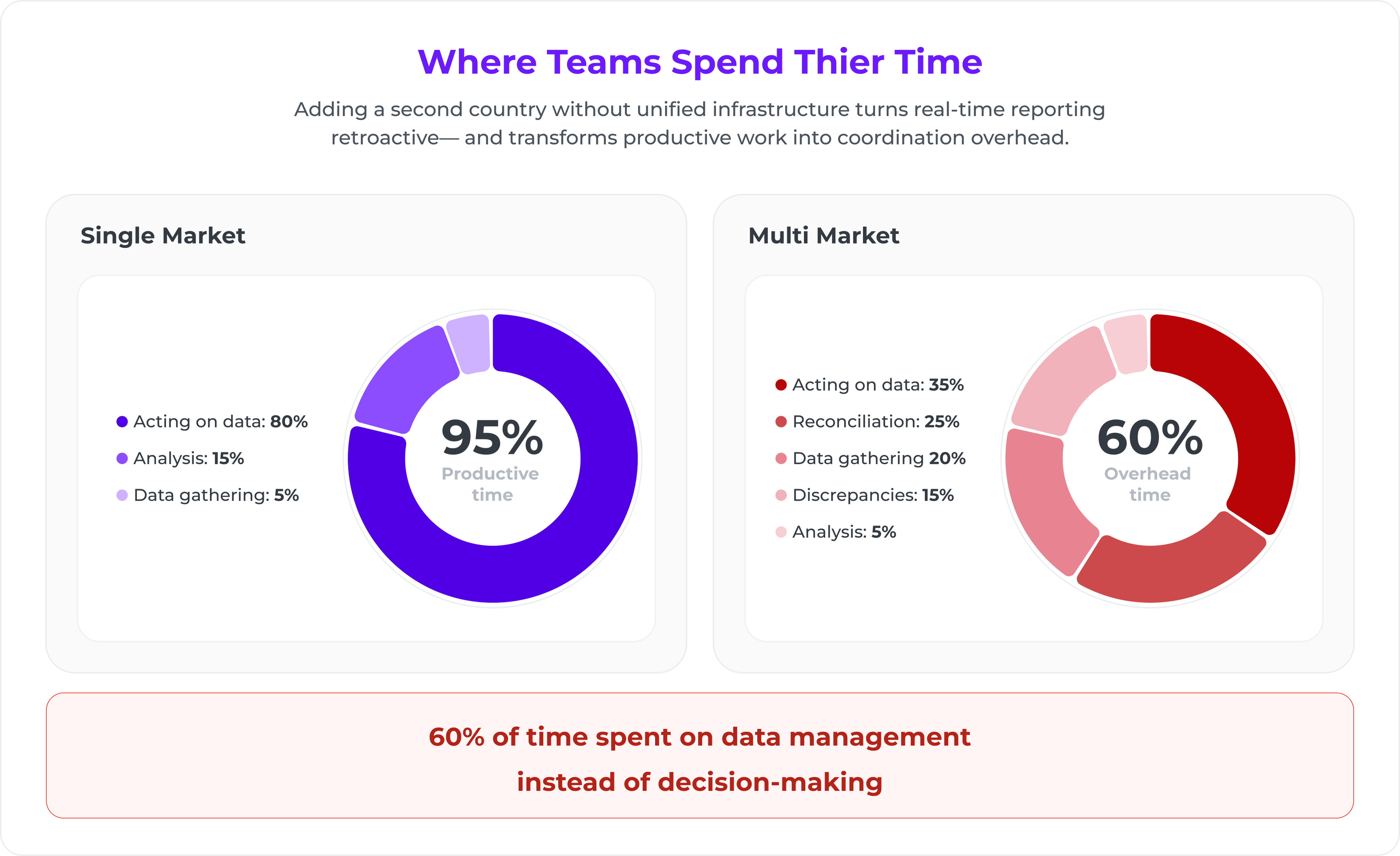
The second country introduces a second 3PL, a second warehouse management system, and a second reporting format. What was once real-time visibility becomes manual reconciliation.
Internal teams start building spreadsheets to stitch data together across disconnected systems—not to gain insights, but just to see what's happening. Organizations relying on manual data reconciliation experience slower decision-making and higher error rates. Teams stop acting on data and start explaining why it doesn't match.
Supply chain costs typically run around 10% of total business costs. The problem is how much of that 10% is lost to friction once teams shift from acting to reconciling.
McKinsey estimates that poor supply chain design can erode up to 30% of operating margins—not through dramatic failures, but through small inefficiencies: inventory duplication, manual reconciliation, fragmented tracking, reporting lag.
Companies with fragmented supply chains carry significantly higher working capital requirements, with inventory turns 20–30% worse than integrated peers.
None of this announces itself as a crisis. It shows up as extra headcount to "sync systems," delays discovering issues until after customers notice, and teams spending hours reconciling yesterday's data instead of acting on today's reality.
Over time, those frictions compound into real margin erosion.
Why Brands Default to Fragmentation (And When It Makes Sense)
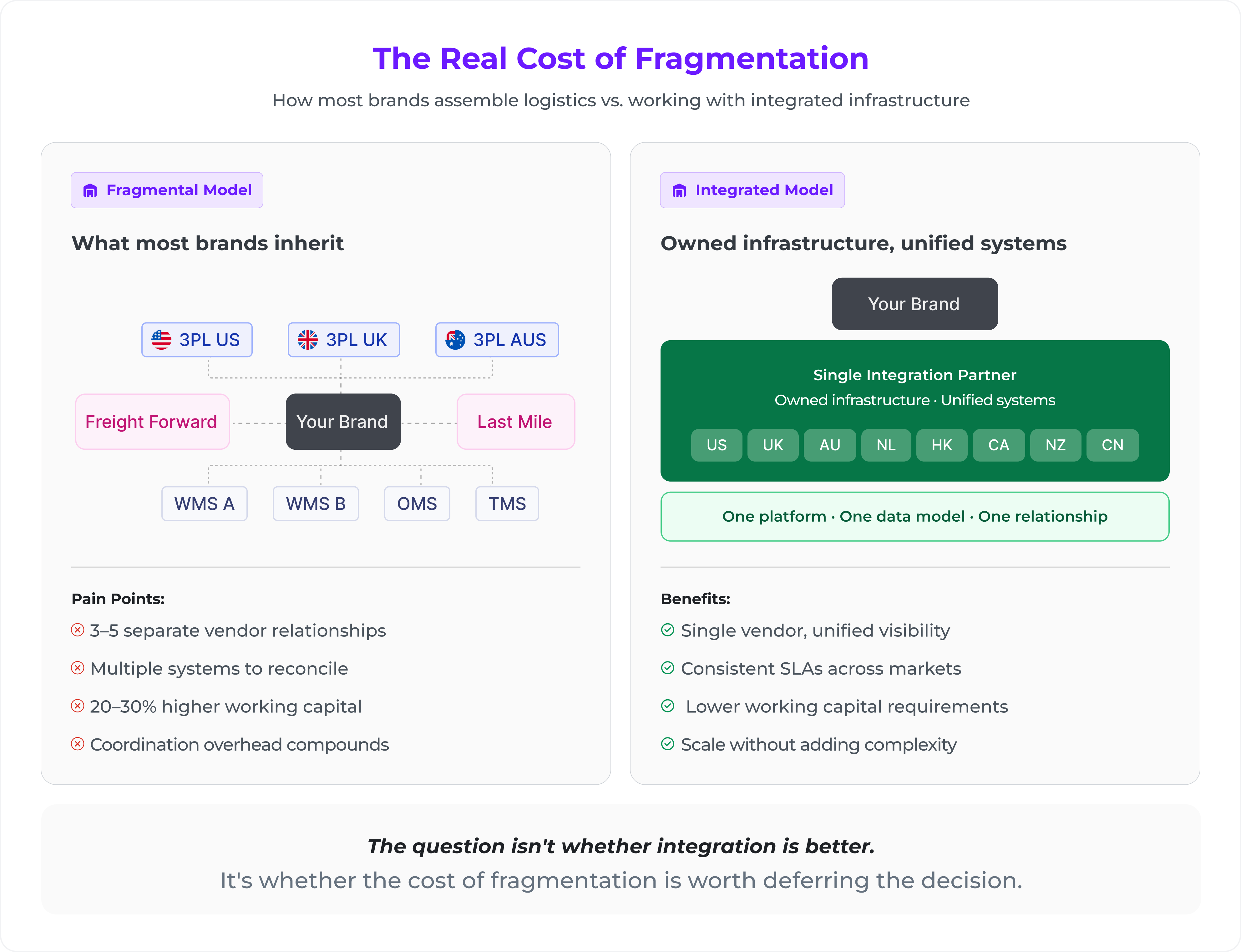
Most brands don't deliberately choose fragmentation. They inherit it by assembling what's available:
Why Brands Default to Fragmentation

Local providers in each market, each with their own systems, pricing structures, and service standards. Initially cheaper, but coordination overhead accumulates.

Handles cross-border movement but requires brands to manage the "last mile" relationship in each country separately. Works at low volumes; breaks under complexity.

Maximum control, maximum capital intensity. Makes sense for brands with predictable, high-volume SKU concentration—rarely the reality for growing DTC brands.

If you're selling 3–5 hero SKUs with highly predictable demand and your margins can absorb 20–30% higher working capital requirements, a fragmented model might work. Most brands discover this isn't their reality once they hit the second country.
The integrated alternative—working with a partner who operates owned infrastructure across markets with unified systems—wasn't always available. Now it is. The question isn't whether integration is better. It's whether the cost of fragmentation is worth deferring the decision.
Fragmentation Is Not Inevitable. It's a Design Choice
The second country is the inflection point. It's the moment where logistics either becomes a connected system or a collection of parallel ones that require constant manual coordination.
Brands that recognize this early make different structural decisions. Instead of accepting fragmentation as inevitable, they look for ways to centralize infrastructure, standardize operations, and maintain a single source of truth across markets—so teams can stay focused on execution rather than spending their time stitching disconnected processes together.
Those that don't take a different path. Fragmentation sets in quietly. Teams adapt. Coordination becomes the job. What started as "just needing to check two systems" becomes building dashboards, reconciling data, explaining discrepancies, and managing the integration layer that was never supposed to exist.
Over time, logistics stops being about moving orders efficiently and becomes about managing the complexity introduced at the second country.
Fragmentation is not a failure of ambition. It is a failure of structure.
And the second country is where that structure is tested for the first time.
Frequently Asked Questions
How much does international expansion actually cost? Beyond obvious expenses (freight, duties, new warehouse contracts), brands typically underestimate working capital requirements. Duplicating inventory across two countries can double stock on hand, with 20–30% annual carrying costs creating $25K–$50K in annual drag for every $100K in excess inventory.
What are the hidden costs of expanding internationally? The largest hidden costs are coordination overhead (manual data reconciliation, multi-system customer service) and inventory inefficiency (safety stock multiplication, poor demand signal across borders). These show up as margin erosion rather than line items.
At what revenue should brands worry about logistics fragmentation? The second country is the trigger, not revenue. A $5M brand entering a second market faces the same structural challenges as a $20M brand—inventory duplication, tracking fragmentation, systems sprawl. Revenue determines how much those inefficiencies cost, but structure determines whether they exist at all.
How do I know if my logistics setup is fragmented? If your customer service team needs to check multiple systems to answer "where's my order," if your finance team manually reconciles inventory reports, or if your delivery promises vary by market without clear customer communication—you're already fragmented.
Ready to Transform Your Logistics?
Book a call to optimise costs, boost efficiency, and enhance satisfaction!
