You’re Not Scaling Internationally, You’re Replicating
Why the playbook that built your first market becomes structural debt by your second
Published: Feb 19, 2026
Last Edited: Mar 26, 2026

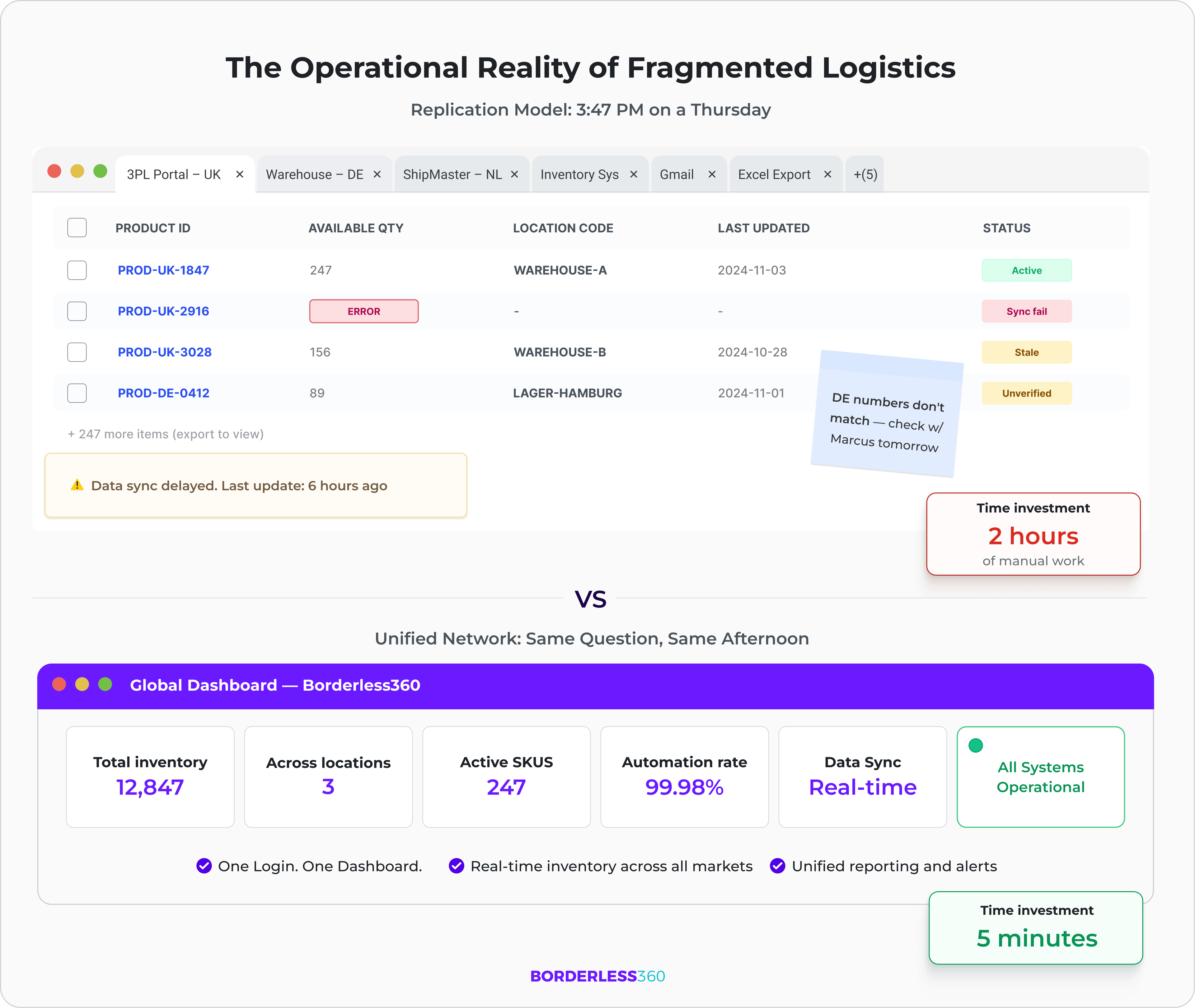
It's Thursday afternoon. Your Head of Ops is preparing a big order for Q4 peak season, coordinating from the manufacturer to 3PLs. Before they can commit to a budget, they need one simple answer: what is our true global inventory position? Not what’s in one warehouse. Total sellable stock across all markets, adjusted for returns and in-transit units.
To get there, they log into three separate warehouse portals, export CSVs with different column structures, reconcile SKU naming inconsistencies, adjust for damaged stock and pending returns, and manually calculate weeks of cover by market. By the time the spreadsheet is built, the number is already drifting.
That's not a reporting inconvenience. That's the operational reality of a logistics model that was replicated, not scaled.
There's a pattern every growing e-commerce brand follows when expanding internationally. It looks like progress. It feels like scaling. And by the time you realise it isn't, the cost of unwinding it is significantly higher than the cost of getting it right in the first place.
The pattern goes like this: find a fulfillment partner in your target market, negotiate rates, connect the integration, ship inventory, start fulfilling orders. It works. So when the next market opens up, you do it again. Same playbook, new country.
By market two, you have separate vendor relationships, several portals, inventory pools, and an ops team that spends more time coordinating between systems than actually improving anything. You haven’t scaled your logistics. You’ve replicated them. And replication is one of the most expensive things a growing brand can do without realising it.
The Playbook That Stops Working
It isn’t. What worked in market one worked because you had a single operation. That simplicity wasn’t operational excellence. It was a structural advantage.
Why market two is where the model breaks
Each new country requires the same standalone setup: source a partner, negotiate independently, build another integration, allocate inventory, add coordination headcount. Nothing compounds. Every market resets effort.
A scaling model creates leverage. A replication model just creates more work. The difference matters.
What Replication Actually Costs
The direct costs are visible: warehouse fees, shipping rates, integration development per partner. What most brands underestimate is everything underneath.
Your team becomes a coordination layer, not a growth engine
This is where it hits first. The ops team that used to focus on improving fulfillment speed, reducing shipping costs, and enhancing customer experience is now spending their time holding disconnected systems together.
We've broken down the specific costs of this shift in detail: inventory carrying costs that quietly double, customer service queries that take 10× longer, reporting that goes from real-time to retroactive, in our blog The Hidden Costs of International Expansion.
But the problem runs deeper than any individual cost centre. It's the model itself.
Every market starts from zero leverage
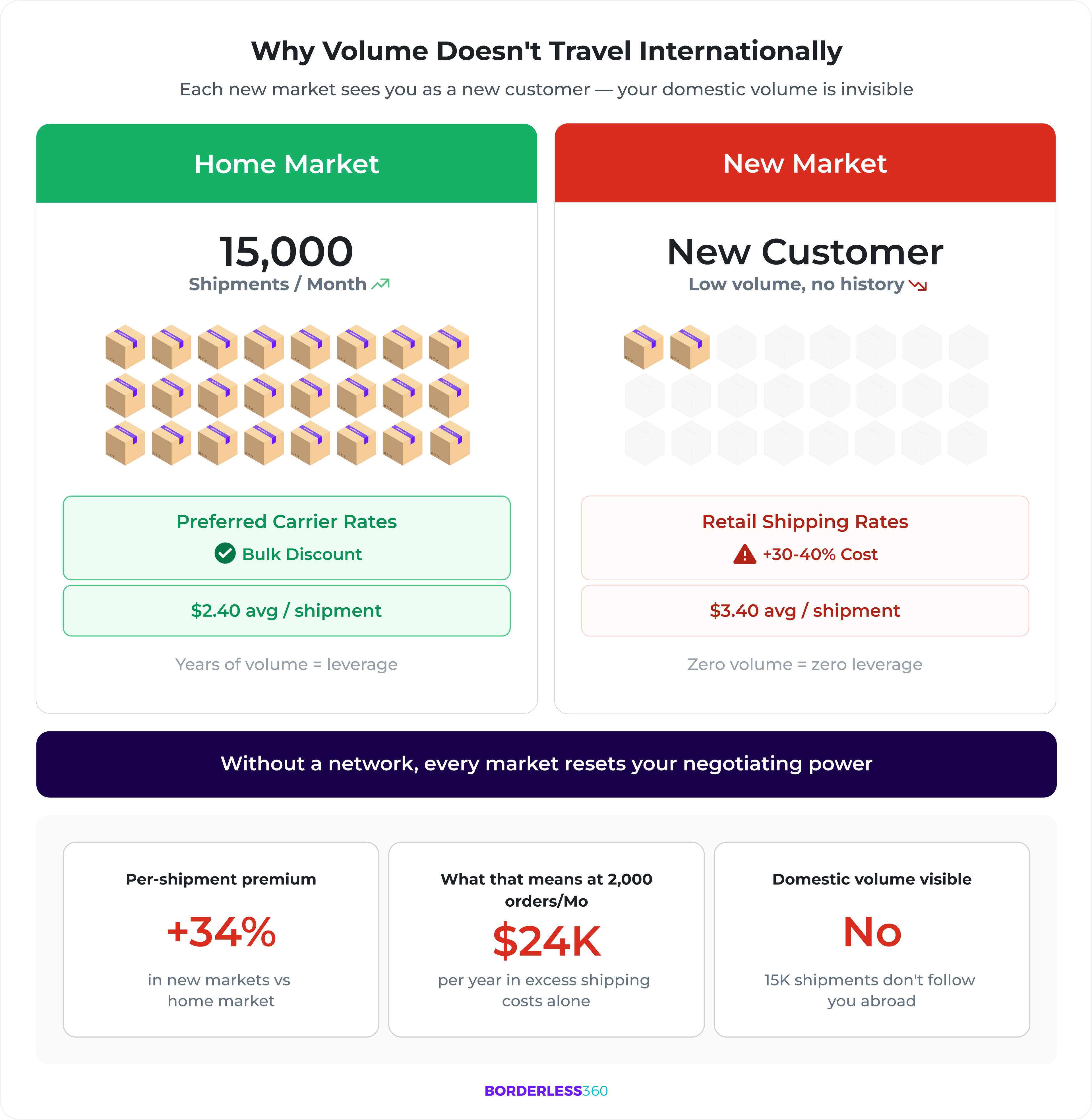
In your home market, you’ve earned volume-based carrier rates over years. Market two doesn’t inherit that. Market three doesn’t either. Each new provider sees you as a new customer with low volume, which means near-retail shipping rates and no negotiating power. Your 15,000 monthly shipments domestically are invisible to the fulfillment provider quoting you in a new region. You’re paying 30–40% more per shipment in newer markets, with no mechanism to consolidate volume because you don’t have a network. You have a list of vendors.
At home, integrations work and tracking flows. But that seamlessness doesn’t cross borders. Shopify doesn’t manage your bonded warehouse in the Netherlands. FBA in a second market is a separate ecosystem with its own inventory and fees. The tech stack that felt effortless domestically wasn’t built to scale internationally.

We recently onboarded a skincare brand doing $8M across Australia and the US. They ran two 3PLs, two carrier contracts, and their supply chain manager spent 25 hours a week coordinating suppliers.
Their US per-unit fulfillment cost was 34% higher, not because rates were worse, but because US volume was invisible to their Australian carrier.
Within 60 days on a unified network, US per-unit cost dropped 22%, they reclaimed two days a week of operator time, and gained global inventory visibility. That’s not a technology upgrade. It’s a structural one.
Inventory decisions get worse with every market you add
With one pool, demand variability is absorbed. Split stock across countries and every SKU becomes an allocation gamble. Do you send 400 units to Australia or hold them in the UK, knowing redistribution means paying duty twice? The result is excess stock in one country and stockouts in another, with capital locked in the wrong place.
Customer experience fragments by geography
A customer in your home market gets the experience your brand was built on. A customer in market two gets whatever their local provider delivers: different packing standards, delivery timelines and returns processes. You’ve built one brand but you’re delivering multiple experiences behind it, and you can’t standardise without renegotiating contracts with providers who have no incentive to align with each other.
The tell-tale symptoms
If you’re not sure whether you’re scaling or replicating, look for these signals. Most teams don’t notice the shift until three or four of these are already true.

If you can’t instantly answer: “How many sellable units do we have globally, and how many weeks of cover is that?”, you’re replicating.

If expansion feels like starting from zero each time, you're rebuilding, not scaling.

If adding a market automatically means adding people just to keep things moving, your system isn't compounding.

You're overstocked in one region. Stocked out in another. Air-freighting to "fix" allocation mistakes. This is what inventory fragmentation looks like in practice.

Delivery times vary wildly. Tracking visibility changes by region. Returns feel seamless in one market and painful in another. From the customer's perspective, it feels like different companies.

If it takes days to understand which country is actually working, you're managing complexity, not leverage.

You want to enter the next market. But you know the current structure will strain under it. That hesitation is usually the clearest signal of all.
If three or more of these feel familiar, you’re not scaling internationally. You’re replicating.
The Moment It Becomes Obvious
For most founders and ops leaders, the recognition doesn’t arrive gradually. It arrives at a specific moment.
It’s the planning session for market four when you realise the playbook hasn’t changed: find a partner, split inventory, add coordination, hope the integrations hold. Only now the complexity is heavier and the team thinner.
Or it’s the quarterly review where someone asks “what’s our per-market profitability?” and nobody can answer without a week of manual work.
That’s when you see it. You haven’t built infrastructure. You’ve accumulated vendors. And vendor accumulation compounds complexity.
From here, there are two paths: keep replicating and accept rising coordination costs, or recognise this is an architecture problem, not a vendor problem, and change the model.
What Changes When You Stop Replicating
The shift is from vendor accumulation to network thinking.
Network thinking means designing logistics as one connected system, not country-by-country setups. Markets plug into shared infrastructure: one integration layer, one inventory view, one carrier strategy. Expansion becomes configuration, not reconstruction.
Your ops team adds markets without adding headcount because processes are consistent across geographies. Inventory decisions are made with full visibility rather than per-market spreadsheets. Carrier rates improve with consolidated volume across your entire operation instead of resetting to zero with every new provider. Customer experience stays consistent regardless of which warehouse ships the order.
The expansion conversation shifts from “who do we use in this country?” to “which markets can our existing infrastructure activate next?”
That’s the difference between replicating and scaling. One adds cost with every market. The other adds markets without proportionally adding cost.
The Compounding Cost of Waiting
Every month you operate with disconnected logistics, the debt deepens. Your team is being trained on processes that don’t scale. Capital sits locked in inventory positions you can’t optimize because you can’t see them clearly. Vendor dependencies harden the longer they run, and the switching cost grows with every integration you’ve built around a provider you’ll eventually outgrow.
Month-by-month compounding (what grows while you wait):
This ties to your carrying cost benchmark (20–30% per year).
You can't rebalance what you can't see, and by the time the spreadsheet tells you Australia is overstocked and the UK is running dry, the air freight bill has already been approved.
Your most senior operators spend their weeks reconciling data across portals instead of optimising carrier mix or negotiating better rates. The work that actually drives margin improvement gets permanently deferred.
Every year, leading retailers invest in faster delivery networks, smarter routing and clearer tracking. The industry baseline improves whether you act or not.
Remember the Thursday afternoon reorder? In a connected network, that answer takes five minutes, not five hours. One dashboard, one inventory position, one decision made with clarity instead of stitched-together CSVs.
What most brands underestimate is this: the decisions made with that clarity compound. Better inventory positioning this quarter means fewer emergency air freight bills next quarter. Consolidated carrier volume in month three means stronger rate negotiations in month six. An ops team that isn't buried in reconciliation starts optimising carrier mix, improving delivery speed and reducing cost per order. This is the work that was permanently deferred under the old model.
Fragmentation compounds. So does infrastructure. Every month on a connected network widens the gap between you and brands still stitching spreadsheets together.
The brands that scale past two markets profitably aren't the ones with the best partners in each country. They're the ones who stopped replicating isolated warehouses and started building a connected network.
If three or more of the symptoms sound familiar, it may be worth a 30-minute infrastructure review. No pitch deck. Just clarity.
Frequently Asked Questions
How do I know if I'm replicating instead of scaling?
The clearest signal is that each new market requires the same effort as the last. If expansion means sourcing a new partner, building a new integration, allocating new coordination headcount, and splitting more inventory every time, you're replicating. Scaling means new markets plug into existing infrastructure with decreasing marginal effort.
What's the difference between a 3PL network and a replicated logistics setup?
A replicated setup uses separate providers in each country, each with independent systems, pricing, and processes. A network operates shared infrastructure across markets; unified inventory visibility, consolidated carrier volume, standardized operations. This means each new country adds capability without proportionally adding complexity.
At what point should I consolidate my international logistics?
The optimal time is before your third market. By that point, coordination overhead from the first two markets is already compounding, and the switching cost of consolidating grows with every integration and vendor relationship you add. Brands that consolidate earlier preserve more margin and scale faster.
How much does logistics fragmentation actually cost?
Beyond direct fees, fragmented logistics typically costs brands 30–40% more per shipment in newer markets (due to reset carrier rates), 15–20 hours per week in manual reconciliation across systems, and 20–30% higher working capital requirements from duplicated inventory. These costs compound with each market added.
Ready to Transform Your Logistics?
Book a call to optimise costs, boost efficiency, and enhance satisfaction!
