
Case Study: Solving the Second Market, Then Scaling to Five
The trigger
A swimwear brand based in Australia had built a solid business: 6,000 orders per month, strong repeat purchase rates, and a local 3PL that handled fulfillment reliably. Operations were lean. The system worked.

When they decided to test the UK, the assumption was simple: replicate the AU model. Ship inventory to a UK warehouse, partner with a local 3PL, fulfil from there.
Within 90 days, the cracks appeared.
Stock had been committed to the UK before demand patterns were clear. Some SKUs sat idle while others sold out. Replenishment took 6-8 weeks door-to-door and this was too slow to react to what was actually selling. Tracking went dark for days at a time while goods moved between freight forwarders, carriers, and the UK 3PL. Support tickets climbed. The ops lead spent hours each week reconciling inventory across two disconnected systems.
The UK wasn't failing because customers didn't want the product. It was failing because the logistics model wasn't designed for a second market.
The diagnosis
The brand's leadership assumed the problem was the UK. Maybe the 3PL was wrong, maybe the freight route needed optimising. But when they mapped the full order journey, a different picture emerged.
The AU operation worked because it was simple: one warehouse, one system, one market. The moment they added a second market with its own inventory, own warehouse, and own fulfillment partner, complexity multiplied. Every decision, including how much stock to send, when to replenish, how to handle exceptions, now had to be made twice, with incomplete information on both sides.
The UK wasn't the problem. Fragmentation was.
The shift
Rather than doubling down on the UK setup or pulling out of the market entirely, the brand restructured around a hybrid model.
Australia: No change. Local fulfillment continued from the AU 3PL. Volume was proven, speed expectations were high, and the infrastructure was already working.
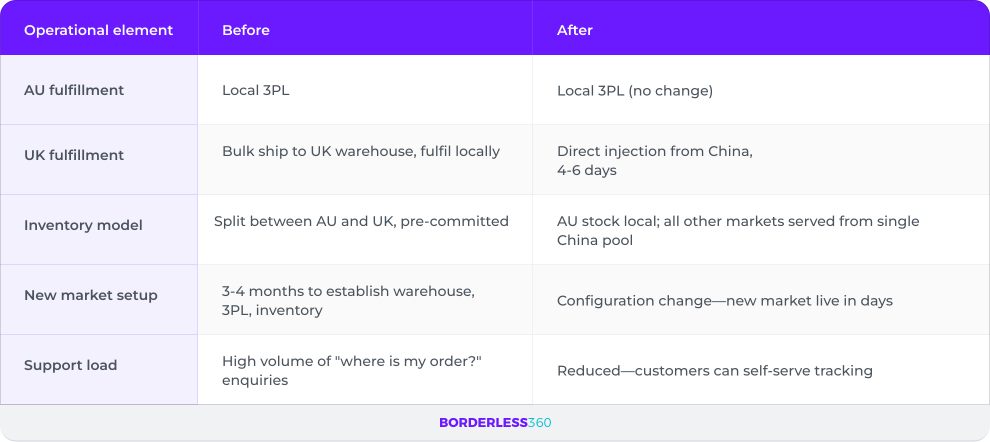
UK and new markets: Inventory moved to a fulfillment centre in China, close to their manufacturing base. Orders were fulfilled directly from China via direct injection into the UK's local delivery network, resulting in 4-6 days to the customer's door.
The key difference: no inventory committed to the UK until a customer actually placed an order. Stock remained in one pool, dynamically allocated based on real demand.
What changed operationally
The outcomes
Within six months of the shift:


The ops lead who previously spent Monday mornings reconciling spreadsheets now spends that time on growth initiatives.
The expansion
Twelve months later, the brand fulfills AU orders locally, exactly the same as before. But the UK, US, Germany, and New Zealand are all served via direct injection from China.
No bulk shipments sitting in overseas warehouses. No six-month infrastructure projects for each new market. No inventory gambles before demand is proven.
The system that broke at country two now comfortably supports country five. The ops team is the same size it was when they shipped to one market.
The takeaway
This case illustrates a pattern that applies beyond one brand or one product category.
The second market breaks logistics not because expansion is inherently hard, but because most setups are designed for one market and then stretched. Adding destinations means adding partners, adding systems, and adding inventory risk. This is all until the complexity outweighs the opportunity.
A hybrid model changes the equation. Keep local fulfillment where it makes sense. Use China as the flexible node for everything else. Launch new markets by turning on routes, not by building infrastructure.
The brands that scale internationally aren't the ones with the biggest logistics budgets. They're the ones whose systems were designed to expand from the start.