
Designing for repeatability, not one-off expansion
A consolidated China-to-world setup is not a shortcut. It is a structural decision.
Rather than treating each new market as a bespoke project, this model is designed to be repeatable. The same core logic applies whether you are launching your second destination or your fifth. What changes is volume and routing, not the underlying system.
In practice, this means moving away from a model where logistics grows by accumulation and toward one where it grows by extension.
Consolidation at the source
The first pillar of a consolidated setup is inventory consolidation close to manufacturing.
Instead of shipping directly from multiple factories to multiple markets, inventory flows into a controlled consolidation point. This allows brands to standardise inbound processes, reduce variability, and create a predictable outbound rhythm.
From an operational perspective, this has several advantages:


This shift alone often shortens the time between production and first sale in a new region, because inventory does not need to wait for full market-specific setup before it can move.
How consolidating at the source improves profit margin
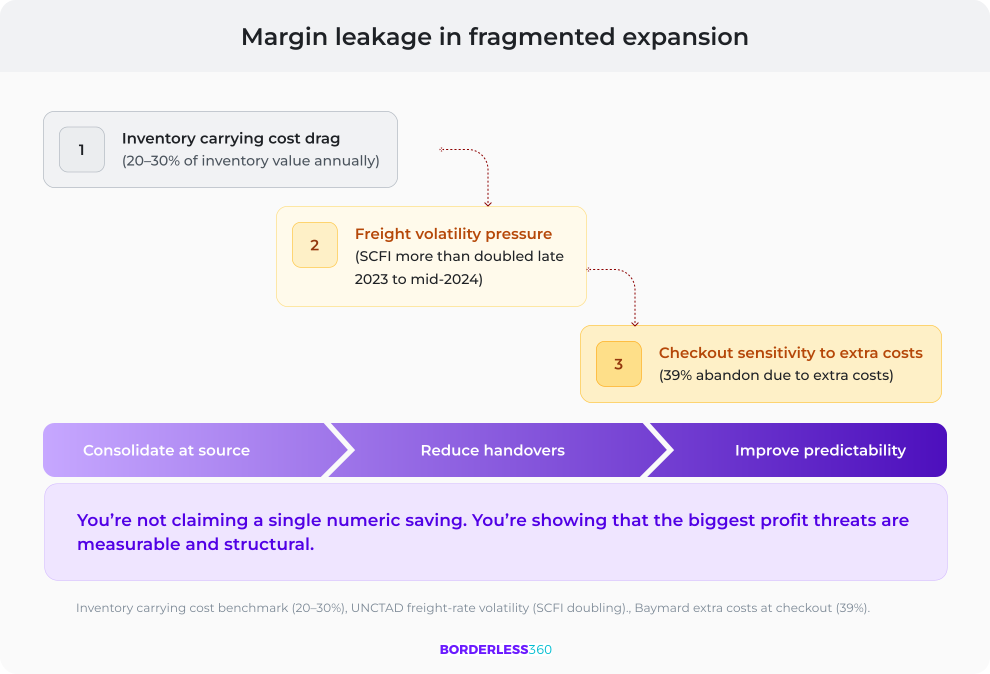
For many ecommerce brands, inbound logistics is an overlooked source of margin leakage.
When goods leave the factory, they often travel through multiple collection points, agents, or ad-hoc arrangements before entering a fulfillment or shipping network. Each additional movement adds cost: local transport, handling, coordination, and delay.
By consolidating inventory close to manufacturing, brands shorten the distance between factory and logistics infrastructure. Fewer factory collections, fewer handoffs, and fewer intermediaries mean lower inbound transport costs before an order is ever shipped to a customer.
The impact is subtle but meaningful. When inbound costs are reduced at scale, the savings flow directly into gross margin, especially for lightweight, high-volume categories like apparel and swimwear.
Centralised inventory intelligence
In fragmented setups, inventory decisions are often made locally and reactively. Teams look at stock levels in isolation and make conservative decisions because mistakes are expensive.
In a consolidated model, inventory intelligence is centralised.
There is one view of available stock by SKU, one view of demand by destination, and one set of rules governing allocation. This does not remove local nuance, but it ensures that decisions are made with full context.
Centralised inventory logic enables brands to:
Allocate stock dynamically based on demand signals
Rebalance inventory without physically relocating it unnecessarily
Launch new markets without duplicating stock too early
The result is not just efficiency, but confidence. Teams can act faster because they understand the trade-offs.
Direct injection as a structural advantage
Direct injection plays a critical role in making China-to-world viable at scale.
At a high level, direct injection means that parcels enter destination delivery networks in a controlled, predictable way, with fewer intermediary handovers. Rather than moving through multiple loosely connected networks, orders follow a designed route with clear ownership.
The benefits are structural rather than tactical:


Importantly, direct injection is not about being the absolute fastest at any cost. It is about reliability and consistency. For many brands, a slightly longer but predictable delivery window outperforms an inconsistent “fast” promise that cannot be met.
Why this model improves profit margin, not just operations
For many ecommerce brands, margin erosion doesn’t come from product costs. It comes from logistics inefficiency that compounds quietly as expansion progresses.
In fragmented setups, each additional handoff introduces another layer of cost: duplicated handling, additional linehaul, higher last-mile rates, exception fees, and operational overhead. These costs rarely show up clearly on a rate card, but they appear in the landed cost of every order.
A consolidated China-to-world model improves margin by shortening the path from factory to customer. By consolidating inventory at the source and injecting directly into destination delivery networks, brands reduce unnecessary transport legs, avoid double handling, and remove margin-diluting intermediaries.
The result is not just lower shipping cost per order, but more predictable unit economics. When logistics costs are stable and transparent, brands can price with confidence, invest in growth without margin shock, and expand without subsidising new markets indefinitely.
Reducing risk through fewer decision points
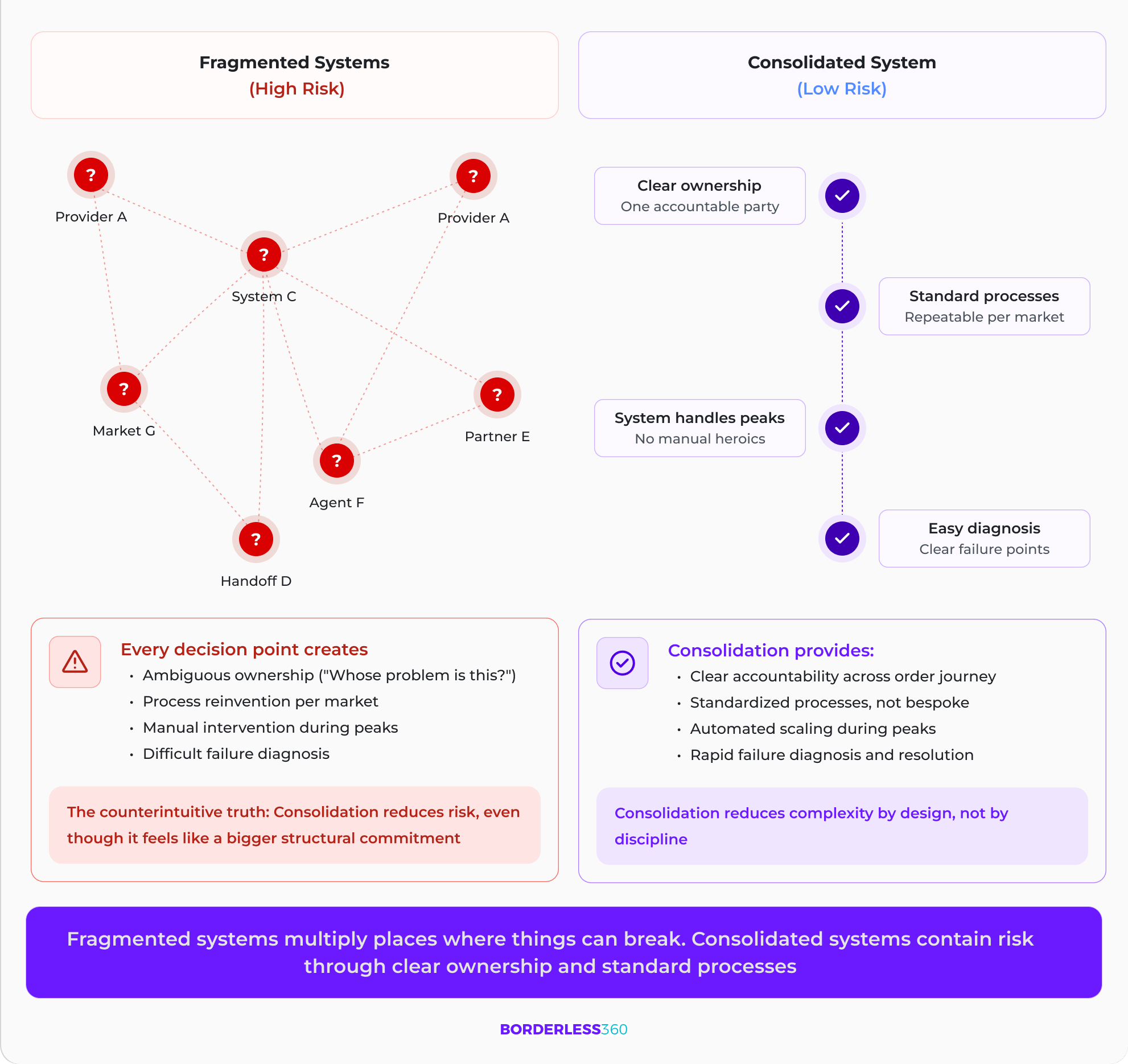
One of the most counterintuitive aspects of consolidation is that it reduces risk, even though it feels like a bigger structural commitment.
Fragmented systems create risk by multiplying decision points. Every additional provider, handover, or system introduces a new place where something can break or become ambiguous.
A consolidated setup reduces risk by:
Clarifying ownership across the entire order journey
Standardising processes instead of reinventing them per market
Reducing reliance on manual intervention during peak periods
Making failures easier to diagnose and resolve
In other words, consolidation reduces complexity by design, not by discipline.
Keeping inventory locally when it makes sense
A common misconception is that China-to-world logistics requires all inventory to live in China. In practice, the strongest setups are hybrid.
Brands often keep inventory in their largest or most mature markets once volume justifies it. Local fulfillment can still offer speed advantages for core regions with predictable demand.
The difference is that local inventory becomes a strategic choice rather than a constraint.
China remains the flexible hub that supports:
New market launches
Seasonal demand spikes
Long-tail destinations
Risk mitigation when local stock runs low
This flexibility is what allows brands to grow without locking themselves into expensive or premature infrastructure.
Expansion without rebuilding the system
Perhaps the most important outcome of a consolidated China-to-world setup is what happens after the next market launch.
When the system is designed correctly, adding an additional destination does not require:
New inventory logic
New reporting frameworks
New support workflows
New partner coordination models
Instead, expansion becomes an exercise in configuration rather than construction. This is what allows brands to scale internationally without scaling operational complexity at the same rate.

Why this matters long term
Global trade volatility, carrier capacity constraints, and shifting consumer expectations are unlikely to become simpler. The brands that perform well over time are those that design logistics systems capable of absorbing change.
A consolidated China-to-world model does not eliminate uncertainty. It contains it.
By anchoring expansion at the source, brands gain a supply chain that is more adaptable, more transparent, and more resilient to the inevitable shocks of global commerce.