China as an origin hub, not a consumer market
This ebook does not treat China as a destination market. There is no requirement for domestic Chinese consumer compliance, local payment methods, or last-mile delivery within China.
China’s role in this model is purely structural: proximity to manufacturing.
By positioning inventory close to factories, brands can reduce the time between production and sale, avoid committing inventory to the wrong market too early, launch new regions without months of setup, and preserve flexibility during demand spikes or slowdowns.
This matters because global trade volatility is no longer an exception. According to UNCTAD, disruptions to maritime trade routes, port congestion, and geopolitical shocks have materially increased lead-time uncertainty over the past five years. What used to be predictable is now variable.
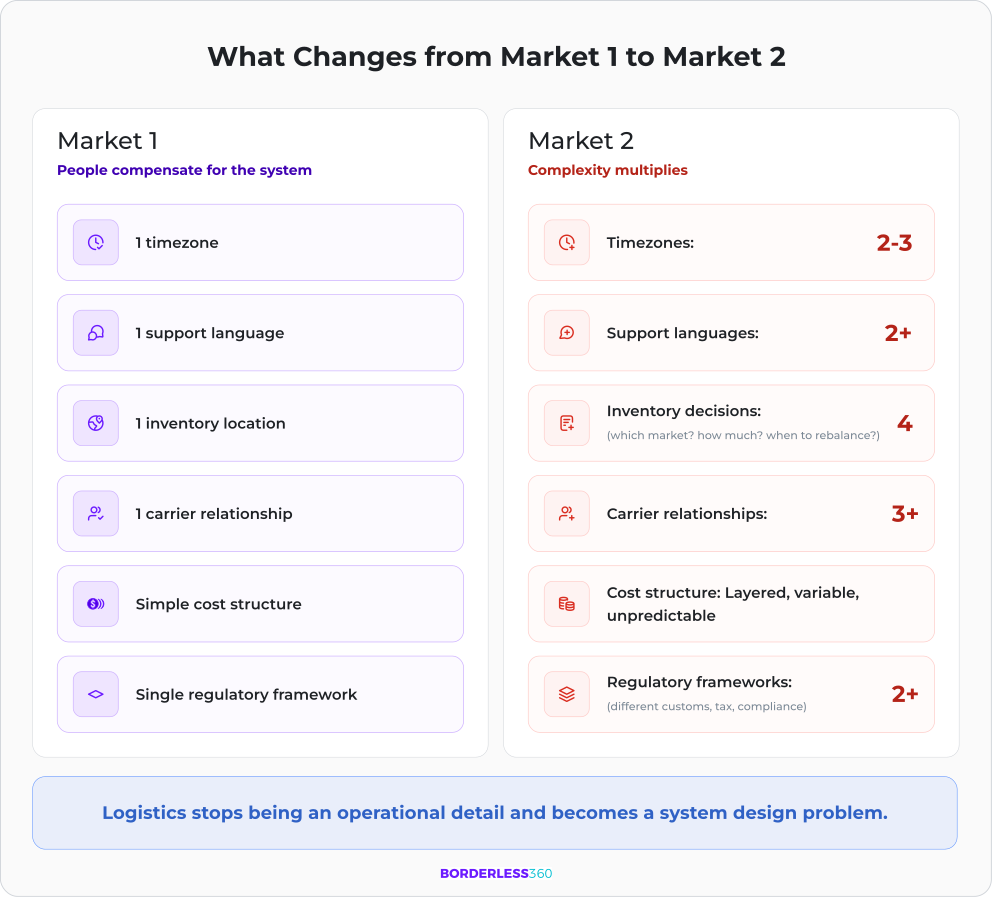
The traditional expansion model forces a sequence: pick your next market, ship inventory there, then find out if it works. It's linear by design. You commit capital to one bet before you have data, then repeat the process for market three, four, five.
This creates a bottleneck that has nothing to do with logistics capability. It's a forecasting problem disguised as an operations problem.
Every unit sitting in a destination warehouse is capital locked to a single market. Get the forecast wrong, wrong SKUs, wrong volumes, wrong region. You're either sitting on dead stock or running expensive repositioning after the fact. The longer your supply chain, the earlier you have to make that bet. Ocean freight plus port clearance plus 3PL receiving can mean 5-7 weeks between production and sellable inventory. That's nearly two months of guesswork baked into every replenishment.
China-as-node changes the sequencing
When inventory consolidates near manufacturing before it commits to a destination, brands gain something more valuable than cost savings: the ability to test multiple markets in parallel without multiplying risk.

Instead of splitting stock across three warehouses and hoping you guessed right, you hold inventory at the source and route orders to wherever demand appears; UK, US, Europe, Asia Pacific . The same stock serves all of them until volume patterns emerge.

You're not forecasting demand in Germany. You're measuring it. Orders flow, you learn, then you decide whether to localise inventory there.

This model doesn't replace destination warehouses, it earns them. Once a market proves itself, you add local stock with confidence. Australia at 3,000 orders a month? Worth holding inventory locally. New Zealand at 400? Serve it from the hub until it grows.

Inventory near the factory is optionality. It can go where customers are, not where you guessed they'd be six months ago.

The point isn't to avoid local fulfillment. It's to stop treating every new market like a standalone infrastructure project. China as a node lets you scale into multiple regions on one foundation—then localise strategically once you have data, not hope.