
Market One Works Because Your Team Covers the Gaps
In the first market, logistics success is often driven by people rather than design. Teams build workarounds. Knowledge lives in individuals’ heads. When something breaks, someone notices quickly and fixes it manually.
This is not a failure of execution. It is how early and mid-stage ecommerce grows.
In a single market, logistics can remain slightly messy without causing existential damage. There are fewer time zones to coordinate. Fewer partners to manage. Fewer regulatory frameworks to understand. Customer expectations are relatively consistent. When something goes wrong, the feedback loop is short.
As long as the volume is manageable, human effort can fill the gaps left by imperfect systems.

Market two changes the operating conditions
The second country introduces a different set of pressures, many of which are invisible until they appear all at once.
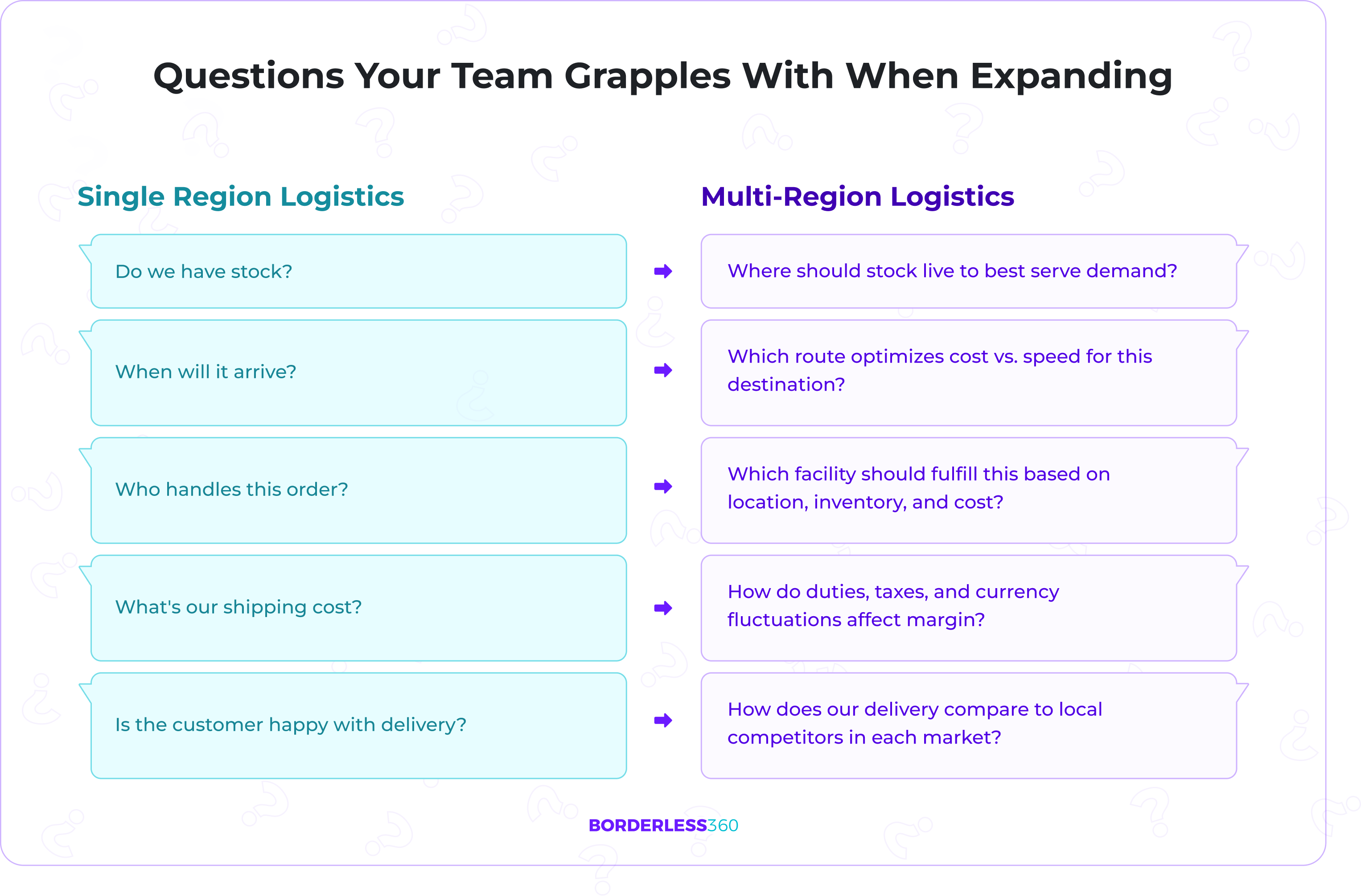
Customers begin comparing delivery experiences across borders, not just against local competitors. Inventory decisions become multi-dimensional, shifting from “do we have stock?” to “where should stock live to best serve demand?”. Support teams are expected to answer questions about orders moving across multiple networks and jurisdictions. Costs become layered, variable, and significantly harder to forecast.
According to McKinsey, shipping cost and delivery speed are two of the top reasons for cart abandonment globally, particularly for cross-border ecommerce. Even small changes in delivery time or cost visibility can materially affect conversion rates.

A swimwear brand shipping 5,000 orders monthly from Australia decides to test the UK. A parcel scans 'handed to airline' in Sydney, then disappears. The customer wants answers. Support contacts the AU 3PL: 'We handed it off.' The freight provider: 'Not our leg once it's airborne.' The UK carrier: 'Never received it.' Three weeks later, the brand refunds the customer and writes off the stock—still not knowing where it went wrong, who was responsible, or how to stop it happening again.
At this point, logistics stops being an operational detail and becomes a system design problem.
China is not the problem. It is the stress test.
Because China already sits at the centre of global manufacturing, it is often where structural weaknesses show up first.
If your products are made in China, your supply chain already begins there. The question is whether your logistics strategy is designed to reflect that reality, or whether it works around it by pushing complexity downstream into destination markets.
Using China as a logistics hub does not create complexity. It reveals whether complexity already exists.